
Natural Beauties
However, the natural scenic of Crete does not stop at the attractive beaches. Many times you will be given the opportunity to come close to nature, either during your daily trips, either when you’re hiking through beautiful trails. And if you’ve never had the thought to go hiking during your holidays, just give it a second thought.
Samaria Gorge
Samaria Gorge, one of the largest canyons in Europe, is one of the major attractions on the island of Crete and of course in the region of Chania.
Each year, about 250,000 – 300,000 visitors cross the gorge of Samaria during its operation, from early May to mid October.
The hike in Samaria gorge begins at the southern edge of Omalos plateau, located about 40 km from the city of Chania, and ends, after six to eight hours of hiking, to the south shore of Crete, on the Libyan Sea.
The 16 km trail descends beside cliffs and through dense forests with rare flora and fauna. The path crosses several times the riverbed into the gorge or is matched to it. Passes by the abandoned village of Samaria, and after passes through the narrow and steep walls of the gorge, ends at the seaside village of Agia Roumeli.
One of the impressive spots in the gorge is the three narrow points of the gorge, the so called “Gates”, of which the narrowest of all is the southern, where the vertical walls within the gorge come close to each other to 3,5 meters.
Kournas Lake
Kournas Lake is the only physical lake in Crete as well as one of the most beautiful nature spots in the prefecture of Chania. The scenery is picturesque, beautiful, idyllic, relaxing. You might see the lake when it shimmers, or you might see it when it mirrors the surrounding hills with the lush bushes.
Its circular dark color was the cause of creating the myth that the Lake is bottomless, while its beauty preserves until today, the legend about the nymph who lives into the lake of Kournas.
Nevertheless, lake Kournas is not an attraction just for the nature lovers. Ride a pedalo or go Kayaking in the lake that changes color due to the dense vegetation and the depth that reaches up to 22.5 meters during the summer season. Furthermore, during summer, when the waters recede to reveal the white sand which gives the green color in the shallows, you have more options. You have the ability to: Sunbathe on the beach or swim or walk on the perimeter where you’ll meet the ducks and other “residents” that live in the wetlands of Lake Kournas.
Sfakia
Sfakia is a region located in the south-eastern part of the prefecture of Chania, Crete. What characterizes this region is a combination of the mountainous and sea landscapes, the White Mountains or Lefka Ori (Greek), which is the second highest mountain in the island of Crete, as well as the many imposing gorges formed between. The whole region is offered for hikes to the many trails located into gorges or along the shore, as well as for relaxation at the beaches, under the hot sun of southern Crete, away from areas that gather the mass tourism. Therefore, if you’re looking for a quiet holiday and the contact with nature through activities such as hiking, Chora Sfakion, Loutro and Agia Roumeli are the main seaside resorts of the region of Sphakia.
Agia Roumeli
Agia Roumeli is a small and quiet seaside village located in Sfakia regional unit, on the south coast of the prefecture of Chania, Crete. Part isolated and not easily accessible. On the north is surrounded by the White Mountains and the Samaria Gorge, and on the south extends the Libyan Sea. Road network does not exist in Agia Roumeli. The village is only accessible by ferry from the neighboring coastal areas. Nevertheless, thousands of visitors pass by Agia Roumeli each year. Undoubtedly, this small village has become known to too many people because it is located at the exit of the enormously popular, beautiful and imposing Samaria Gorge.
During the period that Samaria’s gorge is open, from early May to mid October, walkers who crossing it, finally reach the south shore, seeing it like an oasis for a dip in the crystal clear waters of the sea, for cold drinks, ice cream and launch at the taverns of the village.
Loutro
Loutro is a small picturesque seaside resort village located on the south coast of the prefecture of Chania, in the region of Sfakia, Crete. It is not a real village with permanent residents. It’s a resort that operates mainly in the summer season and maybe on weekends or on holidays throughout the year. Here there are no roads or car traffic, and apart from the ferry that comes and leaves, you will see small boats used either for pleasure or transportation, because the village is only accessible by sea (or walking).
Anopolis
Anopolis is one of the villages of Sfakia region, which is located at the foothills of the White Mountains, in the prefecture of Chania, Crete. The road that continues to the west from the seaside village of Chora Sfakion and ascends the steep mountainside, will bring you to the village at 600 m height above the sea level, and then you will reach the square, an ideal place for a stopover. There, you will see the statue of Ioannis Daskalogiannis who was the leader of the revolution of 1770 against the Turks conquerors of the island.
Aradena
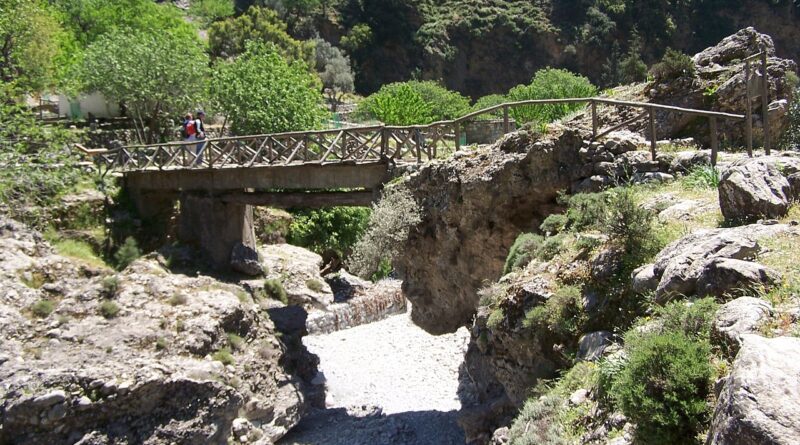
Aradena is located 3 kms west of the village of Anopolis in Sfakia region, Crete, and to get here you will need to follow the road that continues west from the square of Anopolis. Once the road was ending to the east side of Aradena Gorge, and if someone was to come to Aradena, which is located to the west-side of the gorge, had to descent the path that leads to the bottom of the gorge and then to climb to the opposite side. (Descent the same path to enter the gorge if you intend to cross it.). Since the mid 80s, a metal bridge that connects the two sides of the Aradena gorge allows access to the abandoned village by car. The village abandoned around 1950 when a bloody vendetta between two families, was followed a fight for a bell of a goat.
If you are coming here, pass the bridge, park and proceed on foot to the abandoned village of Aradena, where there are still preserved some example elements of the Cretan architecture.
Furthermore, in Aradaina is preserved the Byzantine Church of Archangel Michael dated to the 14th century.
Frangokastello
Frangokastello is located on the south coast of the prefecture of Chania, Crete, in the region of Sfakia, 75 km from the city of Chania and 15 km from Chora Sfakion. Explore in and around the fortress of Frangokastelo, where historic events took place during the period of the Venetian rule, as well as during the subsequent period of the Ottoman rule. Then enjoy the beach of Frangokastelo, in front of the fortress, or the beach of Orthi Ammos, lying just to the east.
Outside the walls of the fortress, you will see a monument that stands there to remind the battles of the Cretans, given in Frangokastelo, for the freedom of Crete. The leftmost of the two inscriptions, right by the two busts, refers to the period of Venetian rule in Crete and honors the six brothers named Patsous, who pioneered for the freedom of Crete.
During their occupation, the Venetians had the need of a fort that would protect the area from the uprisings of the local population but also from pirate raids. So, they chose to build the fortress at the specific site, because it was nearby the ruins of a large Christian basilica church, used as a building material. (On the ruins of the basilica church is built the chapel of Agios Nikitas.). The locals that did not want the fort to be built, derogatory were referred to it as “the castle of the Franks” (i.e. the castle of the Catholics), and they were demolishing during the nights, what the Venetians were built during the day. Eventually, Frangokastello completed in 1374, while the six brothers fell at the hands of the Venetians and hanged on the four towers of the fortress and the main gate.
Sougia
Sougia is a small seaside village located on the southern coast of western Crete, in the prefecture of Chania, 60 km from the city of Chania. Purpose of the regular visitors of this village has always been
- Swimming in the crystal clear waters of the Libyan Sea.
- Sunbathing under the hot sun of southern Crete.
- Free camping on the beach with friendly companionship.
- Hiking in beautiful trails.
- Relaxing vacation.
In general, this is a quiet place, but if you visit it on a weekend in the mid-summer, you will probably find enough people, since it is a favorite place among the residents of the prefecture of Chania for their excursions.
Paleochora
Paleochora is the westernmost seaside resort on the south coast of the prefecture of Chania, Crete. It lies 70 km from the city of Chania, and it will take you about one and a half hour, to get here. Paleohora stands out on the south coast of western Crete. Not because it is built on a peninsula that extends into the Libyan Sea, but because it is the most complete resort on the south coast of the prefecture of Chania.
Compared to the other resorts on the south coast (Chora Sfakion, Loutro, Agia Roumeli, Sougia), which are places where you can relax and come close to nature, Palaiochora is also offered for this, but it also gives you a more cosmopolitan feeling.